


Pumps are among the most demanding loads started by a medium voltage electrical system. When a large centrifugal pump is connected directly across the line, it can draw six to eight times its rated current within the first fraction of a second. At the same time, the sudden application of torque sends a mechanical shock through the pump, piping, valves, and associated equipment.
For operators of water treatment plants, wastewater facilities, desalination plants, irrigation networks, and mining operations, these sudden forces are far more than an electrical concern. They can lead to water hammer, burst pipes, damaged check valves, premature bearing and seal wear, and costly unplanned maintenance.
A medium voltage soft starter for pumps addresses both the electrical and mechanical challenges of motor starting. By gradually increasing motor voltage and torque, it limits inrush current, reduces stress on the power network, and allows the hydraulic system to accelerate smoothly, helping to minimise pressure surges and protect critical infrastructure.
In this guide, we'll explain why controlled starting is essential for pumping applications, what causes water hammer, why a controlled soft stop is just as important as a soft start, and how to choose the right medium voltage starting technology for your application.
1. Why pumps need controlled starting
Centrifugal pumps behave differently from almost any other motor driven load.
At the moment of start, the pump is moving from a standstill to full speed while fluid is still largely at rest in the pipe. The motor has to accelerate both the rotating mass of the pump and impeller and the column of fluid in the discharge line, and it has to do this against a system that resists sudden change.
Starting a medium voltage pump motor direct on line creates several problems simultaneously:
- Electrical inrush. Locked rotor current on an MV motor can reach 600 to 800 percent of full load current, placing heavy demand on transformers, switchgear, and the upstream utility connection.
- Voltage dip. That inrush pulls down bus voltage across the site, which can trip sensitive loads, disturb protective relays, or dim lighting circuits shared with the same supply.
- Mechanical shock at the motor. Full voltage starting applies near instantaneous torque to the shaft, coupling, and bearings, accelerating wear on components that are expensive and slow to replace at MV scale.
- Hydraulic shock in the pipe system. The fluid column is forced to accelerate almost instantly, which is the root cause of the pressure transients discussed below.
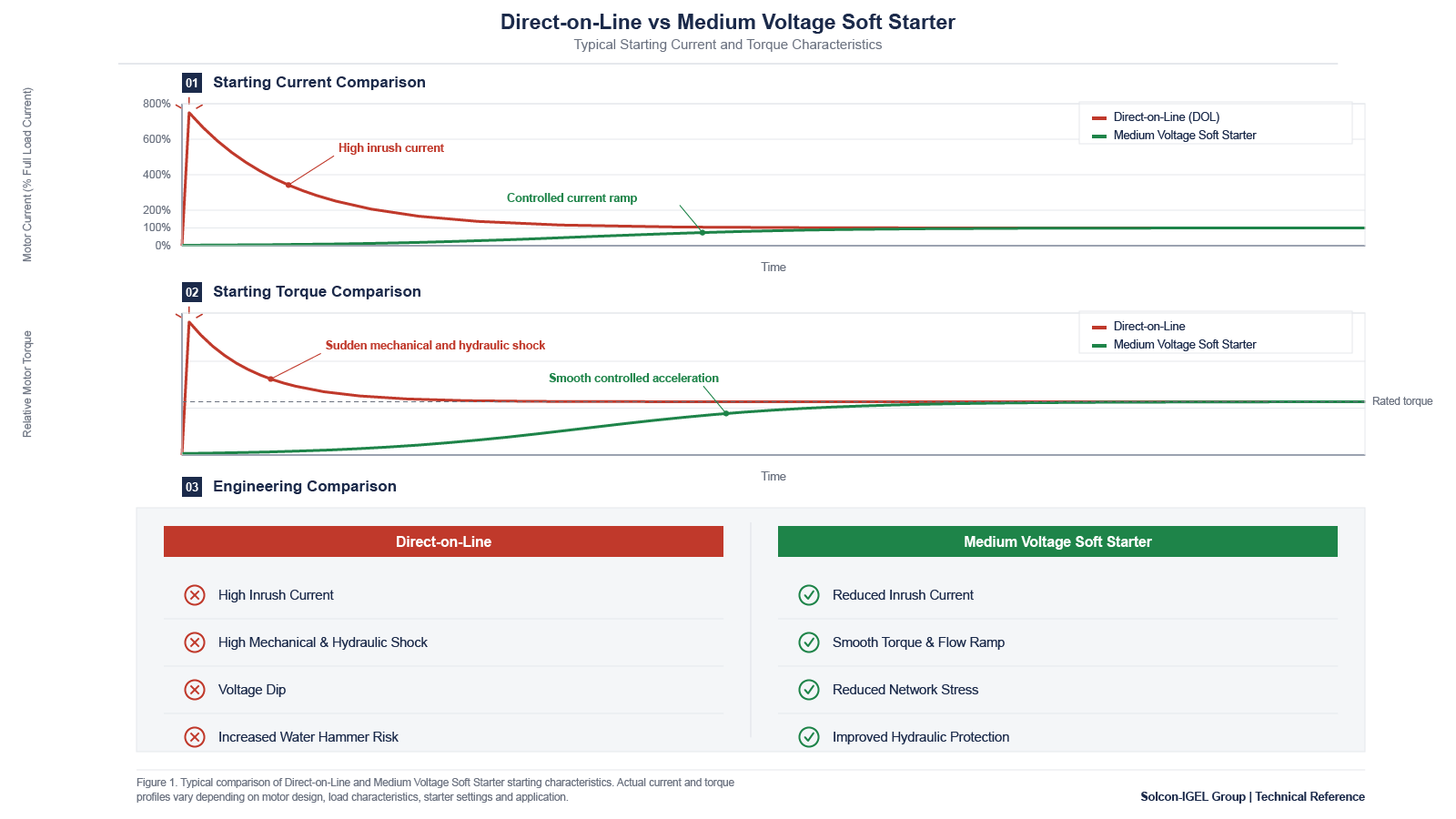
Figure 1. Typical comparison of Direct-on-Line and Medium Voltage Soft Starter starting characteristics. Actual current and torque profiles vary depending on motor design, load characteristics, starter settings and application.
A soft starter ramps voltage, torque, and speed up gradually over a set period, typically ten to sixty seconds depending on the application. The motor reaches full speed smoothly, the fluid column accelerates in step with it, and the entire system, electrical and mechanical, experiences a fraction of the stress it would under a direct or star delta start.
2. What is water hammer?
Water hammer, also called hydraulic transient or pressure surge, occurs when a moving column of fluid is forced to change velocity abruptly. The kinetic energy in the moving water has to go somewhere, and when it cannot be dissipated smoothly it converts into a pressure spike that travels through the pipe network at close to the speed of sound in water, often over a thousand meters per second.
|
In practical terms: a sudden pump start or stop can generate pressure spikes several times the normal operating pressure of the system. Repeated often enough, these spikes fatigue pipe joints, gaskets, and welds until something fails, sometimes catastrophically and often at the worst possible moment. |
The consequences of uncontrolled water hammer include:
- Pipe joint failures and pipe bursts, particularly at bends, tees, and reducers where pressure waves reflect and amplify
- Damaged or slamming check valves, which accelerates valve wear and can cause the valve itself to fail
- Loosened pipe supports and hangers from repeated shock loading
- Cavitation damage to impellers and volutes when localized pressure drops below vapor pressure during the transient
- Fatigue cracking in welded steel pipelines over months or years of repeated cycling
Because the pressure wave travels through the entire connected system, the damage does not always appear at the pump. A soft start or stop event can rupture a joint hundreds of meters away, which is part of why water hammer is frequently misdiagnosed as a pipe quality or installation issue rather than a starting and stopping problem at the source.
Learn more about Reliable Motor Control for Water & Wastewater Systems
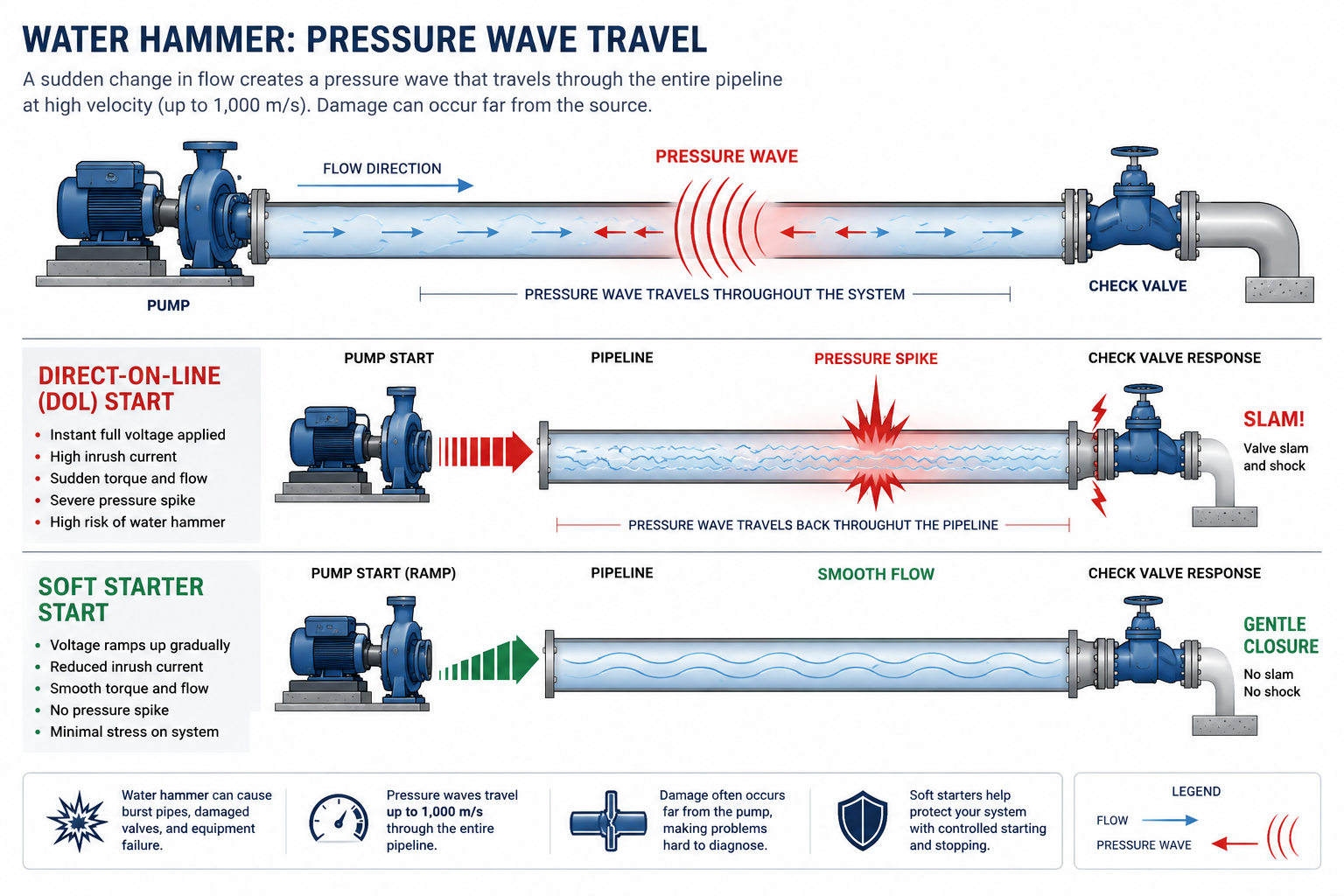
Figure 2 : Water hammer in a pumping system, comparing the pressure transients generated during Direct-on-Line (DOL) starting with the smooth flow achieved using a medium voltage soft starter.
Engineering TipWater hammer damage often occurs hundreds of meters away from the pump, making the root cause difficult to identify. |
3. Why soft stop is as important as soft start
Plants investing in a soft starter often focus entirely on the start ramp and treat stopping as an afterthought, either coasting to a stop or simply removing power. This is a mistake, and for pumps specifically it can undo much of the benefit gained on the start side.
When a pump motor is switched off directly, the pump does not stop instantly. It decelerates on its own inertia curve, which for many pump and pipe combinations is fast enough to leave the fluid column still moving while the pump has effectively stopped driving it forward. The result is the classic water hammer signature: a bang or thud in the pipework immediately after shutdown, most noticeable in long discharge lines and systems with elevation changes.
|
Soft stop extends the deceleration period electronically, ramping torque down over a controlled period so the fluid column decelerates in step with the pump rather than being left to slam against a closing check valve or a column that has already stopped. |
Soft stop is particularly important for:
- Long pipelines and high static head applications, where the fluid column carries significant momentum
- Systems with check valves prone to slam, since a controlled deceleration lets the valve close gently rather than snapping shut against reverse flow
- Vertical turbine and line shaft pumps, where uncontrolled stopping can also stress the shaft and bearing assembly
- Any installation that has already experienced pipe joint failures, valve damage, or unexplained banging noises on shutdown
For pumping applications, a soft starter that offers only a soft start and not a controlled soft stop is solving half the problem. Water hammer generated on stop can be just as damaging as water hammer generated on start, and in systems with long pipe runs it is often worse.
.png?width=1700&height=956&name=soft-stop-vs-coast-stop%20(1).png)
Figure 3: Comparison of controlled motor deceleration versus uncontrolled stopping, highlighting valve slam and water hammer prevention.
|
Remember A soft starter without Soft Stop solves only half the problem. |
4. Starting torque requirements for different pump types
Not all pumps present the same starting challenge, and the right soft starter configuration depends heavily on pump type and how the system is configured at start up.
|
Pump type |
Typical starting torque demand |
Key consideration |
|
Centrifugal pumps (closed valve start) |
Low, roughly 10 to 30 percent of full load torque |
Easiest to soft start; torque follows the square of speed once valve opens |
|
Centrifugal pumps (open valve or against static head) |
Moderate to high, especially with high static head |
Requires enough starting torque to overcome head from the first moment of rotation |
|
Vertical turbine and lineshaft pumps |
Moderate, but sensitive to shaft and thrust bearing loading |
Controlled acceleration reduces shaft and coupling stress in long shaft assemblies |
|
Positive displacement pumps |
High, often 100 percent or more of full load torque from standstill |
Torque does not fall off at low speed the way it does for centrifugal loads; needs a starter sized for sustained high torque delivery |
|
Slurry and mining process pumps |
High, with abrasive wear adding to mechanical stress |
Frequent starts and heavy-duty cycles demand a starter built for repeated high torque cycling |
This is where sizing a soft starter correctly matters as much as choosing the technology itself. A soft starter selected purely on motor nameplate current, without accounting for the torque curve of the specific pump and its starting condition, will either fail to develop enough torque to accelerate the load smoothly or will apply more current than necessary, undermining the reduction in electrical stress that justified the soft starter in the first place.
5. Typical applications
Water treatment
Raw water intake, transfer, and high-service pumps in water treatment plants often operate on long transmission mains where pressure transients can travel significant distances. A medium voltage soft starter provides controlled acceleration and Soft Stop, helping to minimise water hammer, protect critical pipeline infrastructure, and reduce stress on pumps, valves, and the electrical network. Lower inrush current also helps utilities remain within supply demand limits.
Wastewater
Wastewater pumping systems operate under some of the harshest conditions, with frequent starts, abrasive solids, fluctuating flow rates, and check valves exposed to constant wear. A medium voltage soft starter reduces valve slam during shutdown, minimises mechanical stress during starting, and extends the service life of pumps, seals, bearings, and associated pipework while reducing maintenance requirements.
Desalination
High-pressure feed pumps in desalination plants operate against substantial static head and are highly sensitive to hydraulic pressure transients. Controlled starting and Soft Stop reduce mechanical loading on pumps and help protect pipelines, energy recovery devices, and high-pressure equipment. In many desalination facilities, a properly configured Soft Stop is considered essential for long-term system reliability.
Irrigation
Large irrigation schemes often use long buried pipelines that are particularly susceptible to water hammer. Pressure surges can travel considerable distances before causing pipe failures that are difficult and costly to locate. A medium voltage soft starter helps protect the distribution network by providing smooth acceleration and controlled deceleration while also reducing peak electrical demand when multiple pumps are started in sequence.
Mining
Mining applications place exceptional demands on pumping systems, particularly for mine dewatering and slurry transport. These pumps frequently operate with high starting torque, harsh duty cycles, and remote or weak electrical supplies. A correctly sized medium voltage soft starter reduces mechanical stress on the complete pump train while limiting electrical loading on generators, transformers, and long feeder cables, improving overall system reliability in demanding environments.
6. Choosing the right technology
Not every pump application calls for the same starting technology. The right choice depends on starting torque demand, duty cycle, supply strength, and how critical precise speed control is to the process.
HRVS-DN medium voltage soft starter
For the majority of fixed-speed pumping applications, the HRVS-DN Medium Voltage Soft Starter is the ideal solution. It provides controlled acceleration and deceleration, reducing inrush current, minimising hydraulic shock and protecting both the electrical network and the pipeline system.
Typical applications include:
- Municipal water treatment plants
- Wastewater treatment facilities
- Desalination plants
- Irrigation networks
- Mine dewatering systems
- Industrial process water
Learn more about HRVS-DN Medium Voltage Soft Starter
DriveStart Medium Voltage Soft Starter
Some pumping applications require higher starting torque, more advanced motor control or must operate under challenging network conditions. In these cases, DriveStart provides an IGBT-based medium voltage starting solution with enhanced performance and flexibility.
DriveStart is particularly suitable for:
- High-inertia pumping systems
- High-head pumping applications
- Complex industrial pumping processes
- Projects with demanding utility constraints
- Applications requiring enhanced starting performance
Learn more about DriveStart Medium Voltage Soft Starter
Which Technology Is Right for Your Pumping Application?
The table below provides a general guide to selecting the most appropriate starting technology. Final selection should always consider the specific hydraulic and electrical characteristics of the application.
|
Application Requirement |
Recommended Solution |
|
|
HRVS-DN |
DriveStart |
|
|
Fixed-speed centrifugal pumps |
• |
|
|
Water treatment and wastewater |
• |
|
|
Long pipelines requiring Soft Stop |
• |
|
|
Desalination plants |
• |
|
|
High starting torque requirements |
|
• |
|
Complex process applications |
|
• |
|
Challenging utility conditions |
|
• |
|
Every pumping system is unique. Motor characteristics, pipeline configuration, static head, starting torque, and duty cycle all influence the optimum solution. If you're unsure which technology is best suited to your application, our engineering team can help you select the right medium voltage soft starter for long-term reliability and performance. |
7. Common mistakes
- Sizing the starter to the motor alone. Selecting a soft starter based only on motor kW or nameplate current, without checking the torque the specific pump needs at start up, leads to starters that struggle with high head or positive displacement loads.
- Ignoring the stop ramp. Installing a soft starter and leaving it configured for coast to stop or instant stop cancels out much of the water hammer protection the investment was meant to deliver.
- Setting ramp times without checking the pipe system. A ramp time that works well for the motor may still be too fast for a long pipeline with significant fluid inertia. Ramp times should be set with the hydraulic system in mind, not just the electrical one.
- Overlooking check valve behavior. Even with a soft stop, a check valve that is worn, oversized, or poorly matched to the flow profile can still slam. Soft starting and stopping reduce but do not eliminate the need for correctly specified valves.
- Treating current limiting and torque control as the same thing. Current limiting protects the electrical supply but does not by itself guarantee a smooth mechanical ramp. Closed loop torque or ramp control gives more consistent, repeatable starting and stopping behavior across changing line and load conditions.
- Skipping commissioning tuning. Soft starters are frequently left on factory default ramp settings rather than tuned to the actual pump and pipe system, leaving performance well short of what the equipment is capable of.
8. FAQs
What is a medium voltage soft starter for pumps?
It is a solid-state device installed between a medium voltage power supply and a pump motor that controls voltage, current, and torque during starting and stopping, allowing the pump to accelerate and decelerate gradually rather than switching directly on and off line.
How does a soft starter prevent water hammer?
By ramping motor speed up and down over a controlled period, a soft starter allows the fluid column in the pipe to accelerate and decelerate gradually along with the pump, rather than being forced to change velocity almost instantly, which is what generates the pressure spikes behind water hammer.
Is soft stop really necessary, or is soft start enough?
Soft stop is just as important as soft start for most pump applications. A motor that starts gently but stops abruptly can still generate significant water hammer on shutdown, particularly in long pipelines and systems with high static head.
What is the difference between a soft starter and a variable frequency drive for pumps?
A soft starter controls the transition between stopped and full speed but runs the pump at a fixed speed once started. A drive provides continuous speed control throughout operation. Soft starters are typically the more economical choice when the pump only needs to run at one speed, while drives suit applications needing variable flow or energy savings from part speed operation.
Can a soft starter be retrofitted to an existing pump installation?
In most cases, yes. Medium voltage soft starters are commonly retrofitted to existing motors and switchgear as part of upgrade projects aimed at reducing water hammer, lowering electrical demand, or replacing aging star delta or direct on line starting equipment.
How is the correct soft starter size determined for a pump?
Sizing should account for the motor's full load and locked rotor current, the pump's starting torque curve at the actual start up condition (valve open or closed, head present or not), and the duty cycle expected in service, rather than motor nameplate current alone.